Most companies tell stories. The best ones engineer momentum. This is the difference.
Most companies today can articulate a purpose. Very few can turn that purpose into momentum.
Purpose statements are everywhere — on websites, in decks, in brand videos — yet they rarely change client behavior. They don’t accelerate decisions. They don’t build trust at scale. They don’t move businesses forward.
That’s not because purpose doesn’t matter. It’s because purpose alone doesn’t motivate action.
In my work with growing companies and global brands, I’ve seen a consistent pattern: organizations talk a lot about storytelling, but treat narrative as expression rather than leverage. Video becomes a deliverable. Campaigns become moments. And strategy remains disconnected from execution.
The result is work that looks good, feels aligned, and ultimately stalls.
The companies that break through do something different. They don’t just articulate why they exist — they formulate their why into narratives designed to move people. They treat story as a growth mechanism, not a communications layer. And they engineer momentum instead of hoping resonance will be enough.
That’s the shift this piece is about.
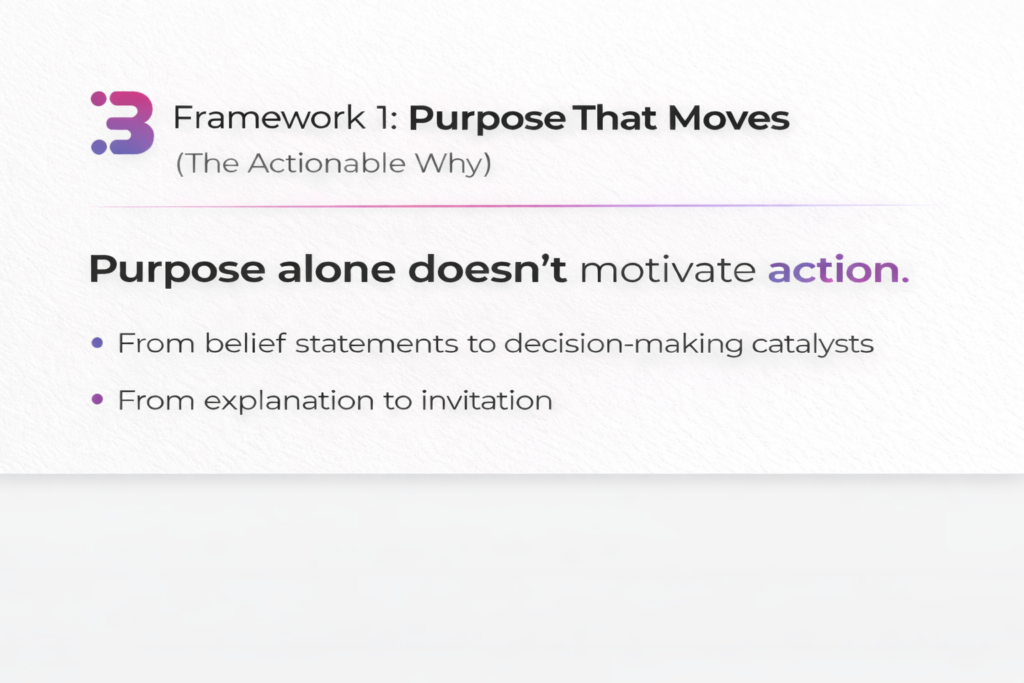
Framework 1: Purpose That Moves (The Actionable Why)
Most companies believe their challenge is clarity — if they can just articulate their purpose more clearly, momentum will follow.
It rarely does.
The real issue isn’t clarity — it’s agency. Purpose is framed as belief, not as force. Companies write purpose statements to sound true or inspiring. But clients don’t act because something is true. They act because it matters to them — because it intersects with their priorities, risks, and ambitions.
That’s the gap.
Purpose That Moves is the discipline of formulating a company’s strategic “why” into narratives that are engineered to motivate behavior — not just signal values.
This requires a shift in how purpose is treated:
From internal alignment to external motivation
From belief statements to decision-making catalysts
From explanation to invitation
Instead of asking, “What do we stand for?” the more useful question becomes: “What should this purpose cause someone to do?”
When purpose is formulated with action in mind, narrative changes shape. It becomes clearer. Sharper. More selective. And more relevant to the client’s world than the company’s internal story.
Most organizations stop at articulation because articulation feels complete. The words are written. The video is produced. The box is checked.
But articulation without activation leads to stories that resonate without converting, videos that are admired without being acted on, and purpose that feels meaningful but inert.
Companies that use purpose as leverage treat it as raw material, not a finished product. They expect it to do work.
My approach begins by pressure-testing purpose against reality:
What decision should this story influence?
What hesitation should it reduce?
What future should it help the client imagine choosing?
Only then does narrative take shape.
Video becomes the medium not because it’s engaging, but because it’s uniquely capable of carrying emotion, clarity, and intent at the same time. When done right, it doesn’t just express purpose — it translates it into momentum.
That’s the difference between a why that sounds good and a why that moves.
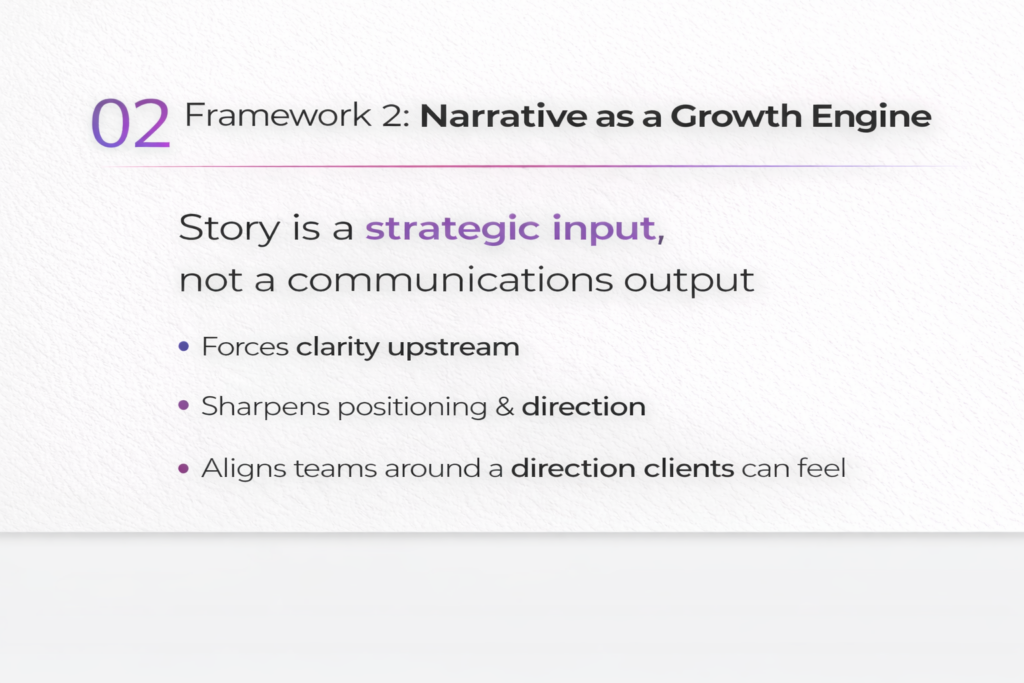
Framework 2: Narrative as a Growth Engine
Most organizations treat narrative as a layer applied after strategy is set. Messaging comes later. Video comes last.
That sequencing is the problem.
When narrative is treated as expression, it decorates decisions that have already been made. When it’s treated as a growth engine, it shapes those decisions upstream.
Narrative as a Growth Engine is the idea that story isn’t a communications output — it’s a strategic input.
When narrative is taken seriously, it forces clarity:
What actually differentiates this company?
What problem does it truly exist to solve?
Why should a client choose this path instead of another?
If those questions can’t be answered clearly in story form, they usually aren’t clear in the business itself.
This is why video becomes a strategic lever. It doesn’t tolerate ambiguity. Story exposes weak positioning faster than any deck or memo.
Treating narrative as a growth engine requires leadership involvement. It requires decisions. And it requires trade-offs.
So instead, narrative is often kept at arm’s length. It’s asked to explain strategy rather than inform it. Video is commissioned to support initiatives rather than clarify them.
The result is alignment without acceleration.
Organizations that grow through narrative do the opposite. They use story to pressure-test strategy, sharpen positioning, and align teams around a direction that clients can actually feel.
In these companies, narrative doesn’t follow growth. It helps create it.
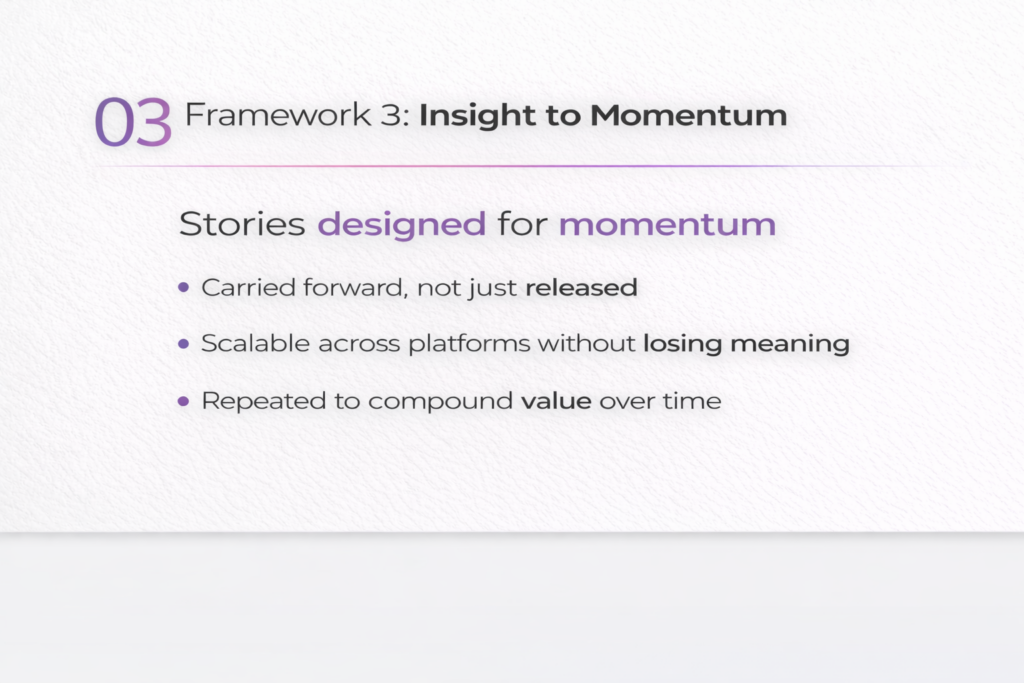
Framework 3: Insight to Momentum
Insight is necessary. Resonance is valuable. Neither is sufficient.
What businesses need is momentum — sustained movement in how they are perceived, chosen, and trusted over time.
This is where most storytelling breaks down.
A story can be meaningful without being useful. It can resonate emotionally without changing behavior.
Insight to Momentum is the discipline of designing narratives that don’t just land — they carry forward.
Stories built for momentum are designed:
To be repeated, not just released
To scale across platforms without losing meaning
To compound value over time rather than peak and disappear
Momentum isn’t created by volume. It’s created by coherence.
When purpose is actionable, narrative is strategic, and video is treated as a system rather than a moment, stories begin to reinforce one another. Each one does a little less explaining and a little more confirming.
That’s when trust accelerates. That’s when choice becomes easier. That’s when story stops being a cost and starts behaving like an asset.
The Reframe
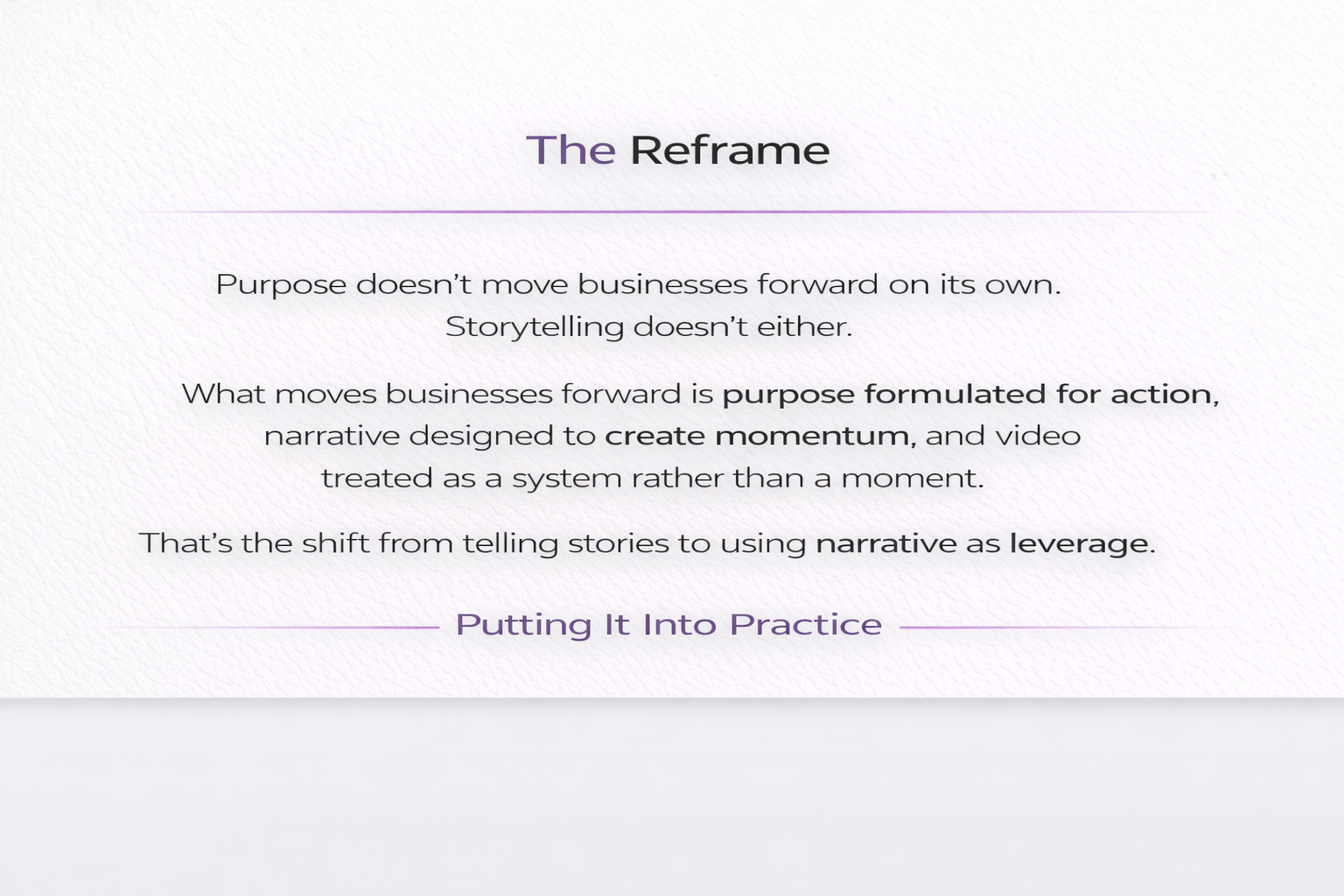
Purpose doesn’t move businesses forward on its own. Storytelling doesn’t either.
What moves businesses forward is purpose formulated for action, narrative designed to create momentum, and video treated as a system rather than a moment.
That’s the shift from telling stories to using narrative as leverage.
Putting It Into Practice
Most companies won’t make this shift because it requires decisions they’ve been avoiding.
It requires choosing what the story is actually for — not just what it says. It requires treating video as strategic infrastructure, not creative output. And it requires leadership willing to let narrative inform strategy, not just explain it.
The companies that do make this shift don’t need more content. They need a system.
That’s what the Video Playbook is: a framework for turning purpose into repeatable momentum. Not through one-off campaigns or isolated videos, but through narrative architecture designed to compound over time.
If the thinking in this piece resonates, the playbook is how you operationalize it.